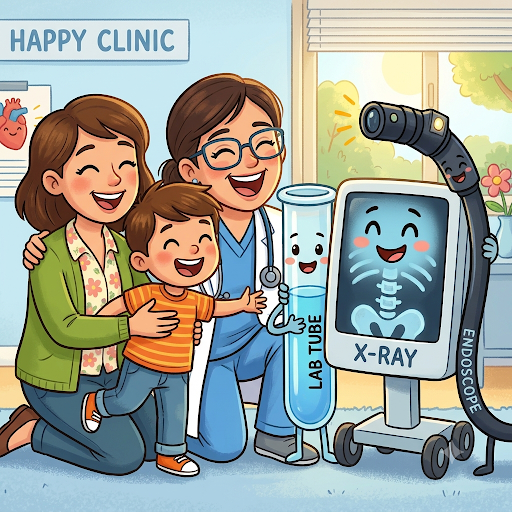
One of the most important factors in a child’s recovery is not only choosing the right specialist—it is building a strong partnership between the physician and the family. Pediatric medicine works best when both members of the healthcare team fulfill their responsibilities.
The Doctor’s Responsibility
A pediatric gastroenterologist is trained to diagnose and treat far more than constipation or stomach pain. The specialty includes expertise in:
- Nutrition and infant formulas
- Growth and failure to thrive
- Feeding disorders, gastrostomy, and nasogastric tube feeding
- Liver and pancreatic diseases
- Metabolic disorders
- Food allergies and immune-mediated diseases
- Infections and inflammatory bowel diseases
- Vomiting, diarrhea, constipation, abdominal pain, reflux, gastritis, enteritis, and colitis
Making the correct diagnosis requires careful medical judgment. Rather than relying on guesswork, physicians follow a systematic evaluation based on the child’s symptoms, physical examination, response to treatments, follow up visits, laboratory testing, imaging studies, and, when medically indicated, endoscopy or colonoscopy.
Each test is ordered for a specific medical reason. Blood work, stool studies, X-rays, ultrasound, CT scans, and MRI, endoscopy, colonoscopy, capsule endoscpy, breath test examinations each provide unique information that cannot be replaced by another test.
The Parent’s Responsibility
Parents are the most important advocates for their child. Their role is essential to successful medical care.
Responsible parents:
- Complete all recommended laboratory and stool studies.
- Follow fasting or preparation instructions when required.
- Obtain imaging studies as ordered.
- Administer medications exactly as prescribed.
- Keep follow-up appointments.
- Inform the physician if symptoms change.
- Provide previous medical records, laboratory results, and imaging studies before the visit whenever possible.
- Ask questions whenever instructions are unclear.
These responsibilities are not simply office policies—they are critical components of good medical care. Without complete information, even the most experienced physician may be unable to reach the correct diagnosis or provide the best treatment.
Why Compliance Matters
Every recommendation made by your physician is intended to answer an important medical question. Skipping laboratory tests, delaying imaging studies, stopping medications without discussion, or missing follow-up appointments can delay diagnosis, prolong illness, and sometimes allow a serious condition to progress unnoticed.
Medical decisions are based on objective evidence. When recommended evaluations are incomplete, treatment becomes less precise and may require additional visits or repeat testing.
Parents who actively participate in the diagnostic process help their children receive faster, safer, and more effective care.
When Non-Compliance Becomes Medical Neglect
Most parents want the very best for their children. Occasionally, however, repeated failure to obtain medically necessary testing or treatment places a child’s health at risk.
Ignoring recommendations, repeatedly failing to complete essential evaluations, or refusing medically necessary follow-up may delay the diagnosis of conditions such as inflammatory bowel disease, liver disease, nutritional deficiencies, infections, or other potentially serious illnesses.
Healthcare providers have both an ethical and legal responsibility to advocate for the child’s well-being. Our shared goal is always to educate families, improve communication, and help every child receive appropriate medical care and involve social services if neglect is suspected.
Building a Successful Medical Team
The best outcomes occur when physicians and parents work together with mutual trust, respect, and open communication.
The physician contributes medical knowledge, clinical experience, and diagnostic expertise. Parents contribute careful observation, timely follow-through, and day-to-day care at home.
Neither role can replace the other.
A successful medical team is built on shared responsibility. When doctors and parents work together, children receive more accurate diagnoses, more effective treatment, fewer complications, and the greatest opportunity for a healthy future.
At Pediatric Gastroenterology and Nutrition, we are committed to partnering with families who share our dedication to providing thoughtful, evidence-based, and compassionate care for every child.